🤖 Legs Are Optional

Good Morning, Roboticists!
Legs are optional now—not just for robots, but for the way we think about progress.
HOME TECH
Legs Are Optional When Chores Stay on One Floor
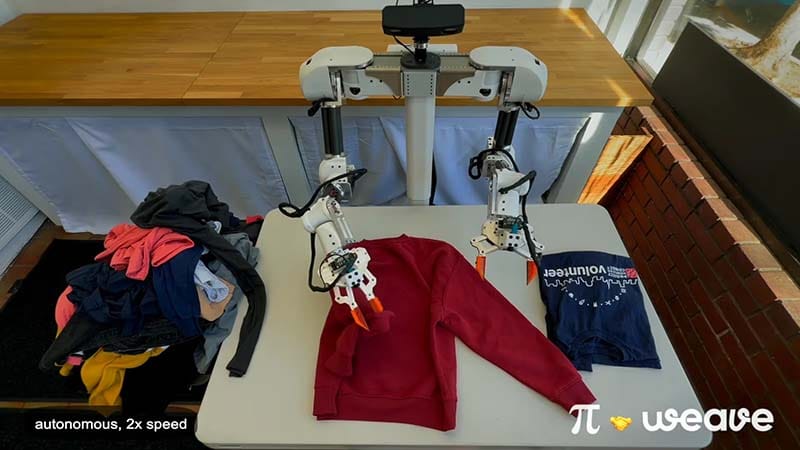
👀 What’s happening: LG unveiled CLOiD at CES 2026, its first multitasking home robot built to fold laundry, unload dishwashers, and handle simple kitchen prep. It uses two articulated arms on a wheeled base and operates inside LG’s ThinQ smart home system. The design skips legs entirely and stays focused on repeatable domestic tasks.
🌍 How this hits reality: Most homes already constrain chores to kitchens, laundry rooms, and living areas. CLOiD is optimized for that reality. Wheels mean lower cost, better stability, and fewer safety risks than biped robots. Two seven degree arms and five finger hands cover 90 percent of object handling. The tradeoff is stairs, but most appliances live on one floor anyway.
🤖 Key takeaway: Legless home robots may win by arriving first and working reliably. If CLOiD performs in real homes, the mainstream path favors grounded operators tied to appliance ecosystems, not humanoids chasing full mobility before usefulness.
ROBOT DOG
A Robot Dog That Refuses to Slow Down for Stairs
👀 What’s happening: Pudu Robotics released a real time demo of its D5 hybrid robot dog climbing multiple stair flights at roughly 1.5 m/s. The robot rolls on wheels, switches to legs mid motion, clears the stairs, then resumes rolling without stopping. No edits. No pauses. Just continuous movement.
🌍 How this hits reality: Most robots treat stairs as exceptions that force slowdowns, checks, and mode switches, typically dropping speed to around 0.3–0.6 m/s. Real facilities are full of these breaks. Airports, factories, metro stations, and campuses lose minutes per run. A system that keeps speed while switching locomotion reshapes patrol timing, inspection coverage, and labor substitution math at scale.
🤖 Key takeaway: The innovation is not just stairs but continuity. Wheels handle efficiency. Legs handle disruption. If this holds outside demos, hybrid mobility stops being a compromise and becomes the default for industrial robots operating in mixed terrain environments.
HOME TECH
Robot Companionship Shifts From Features to Presence
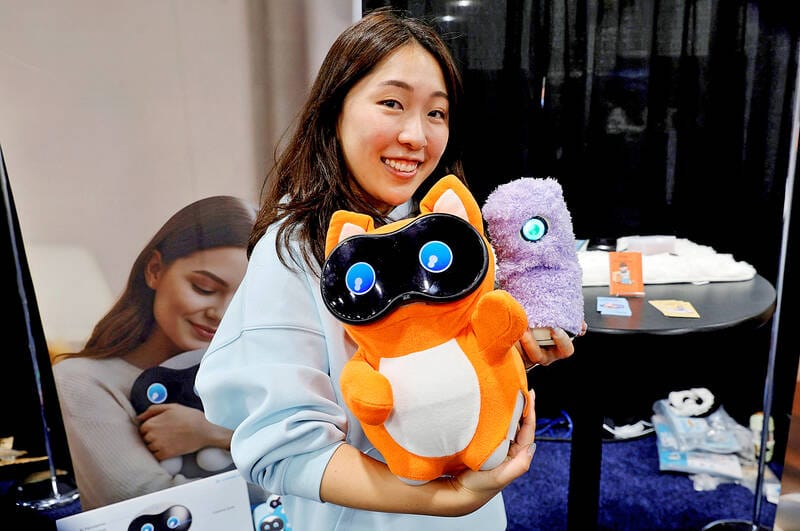
👀 What’s happening: At CES 2026, Japanese startup Ludens AI introduced two companion robots built around presence and learning rather than productivity. Cocomo follows you, stays warm to the touch, reacts through movement and sounds, and gradually adapts to your habits. Inu sits on a desk, responding with subtle motions while learning familiar voices and patterns over time.
🌍 How this hits reality: Most earlier companion robots were task machines pretending to be friendly. They answered questions, rolled around, or ran demos, then stalled once novelty faded. Ludens flips that model. No jobs, minimal speech. Instead, it bets on body temperature, proximity, imitation, and long term behavior learning. This lowers autonomy complexity and hardware cost while targeting emotional stickiness rather than utility.
🤖 Key takeaway: This is a cleaner bet on companionship as a product category. If users value presence over capability, robot pets scale sooner than helpers, and the first real market for consumer robots may be emotional, not functional.
QUICK HITS
- Boston Dynamics announced at CES 2026 that Atlas has entered production, with initial deployments at Hyundai and Google DeepMind.
- Lyte, founded by former Apple Face ID engineers, raised $107 million to build a “visual brain” platform aimed at improving robot perception and safety.
- Qualcomm debuted its Dragonwing IQ10 robotics platform at CES 2026, using the Motion 2 humanoid to highlight its embodied, low-power approach.
- SwitchBot introduced the Onero H1 humanoid at CES 2026 as an orchestrator for its smart home ecosystem.
- At CES 2026, FrontierX introduced Vex, a pet-following robot that films and auto-edits video, alongside the human-focused companion robot Aura.
TOGETHER WITH US
AI Secret Media Group is the world’s #1 AI & Tech Newsletter Group, reaching over 2 million leaders across the global innovation ecosystem, from OpenAI, Anthropic, Google, and Microsoft to top AI labs, VCs, and fast-growing startups.
We operate the industry’s most influential portfolio of newsletters, each shaping a different frontier of the AI & Tech revolution:
Be Smarter in 5 Minutes
- AI: AI Secret
- Tech & Business: Bay Area Letters
- Marketing: Marketing Secret
Discover the Future Products
- AI Launchpad: Oncely
- Robotics: Robotics Herald
- Hardwares: The Hardwire
We've helped promote over 500 Tech Brands. Will yours be the next?
Email our co-founder Mark directly at mark@aisecret.us if the button fails.